


A new starter cannot log in on their first morning. A laptop needs replacing. Microsoft 365 asks for a decision nobody has time to research. These are small interruptions, but they add up quickly when IT responsibility sits alongside running the business.
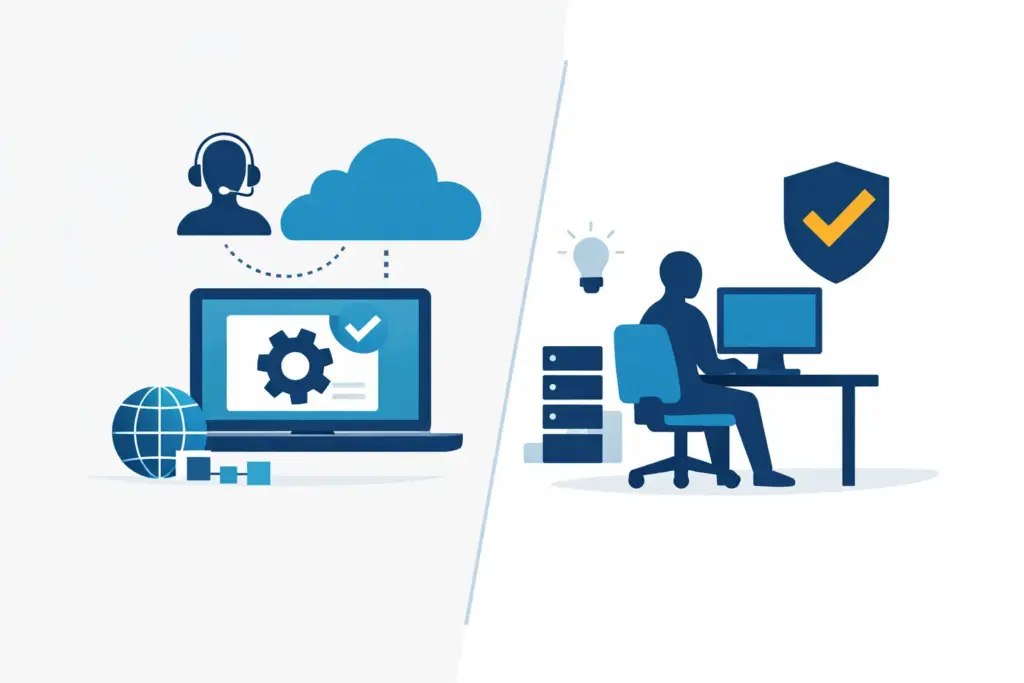
The question of outsourced IT versus internal hire usually comes up at this point. Your business has grown beyond asking the most confident person in the office to fix things, but a full-time IT salary may feel like a large commitment. Both options can work well. The sensible choice depends less on which model sounds better and more on the support your team genuinely needs.
What are you really hiring IT for?
It is tempting to compare an IT provider’s monthly fee with an employee’s salary and stop there. That is understandable, but it misses the wider job.
For a small business, IT is rarely one role. It includes helping people when something stops working, looking after devices and accounts, keeping software up to date, planning replacements, protecting company information, checking backups and making sure someone can make a clear recommendation when a decision is needed.
An internal IT hire may be excellent at some of these areas, particularly if they know your systems and colleagues well. But one person cannot be available all the time, nor can they be a specialist in every part of IT. Equally, outsourced support is not automatically the answer if your business needs someone physically present every day.
The useful question is this: do you need a person in the office, or do you need dependable IT ownership?
The real cost is wider than salary
An internal hire brings costs beyond their stated salary. There are employer costs, holiday cover, training, equipment, recruitment time and the practical risk of relying heavily on one person. If they are away or move on, the business still needs support.
That does not make an internal hire a poor investment. For some organisations, having a knowledgeable person on site is genuinely valuable. It simply means the comparison should be fair.
Outsourced IT is usually easier to budget for. A managed service is generally charged as a regular monthly cost, covering an agreed level of day-to-day support and ongoing care. This can make financial planning simpler, especially for businesses with 10 to 50 users that need consistent help but do not have enough work to keep a capable IT professional fully occupied every day.
There is also the cost of unmanaged interruptions. When office managers, directors or technically minded staff keep stepping in to solve IT gremlins, their own work gets delayed. The issue may be fixed eventually, but it has quietly pulled attention away from customers, operations and growth.
Outsourced IT versus internal hire: the coverage question
Coverage is often where the difference becomes clearest.
With one internal IT person, there is a familiar face who understands the business and can walk over to a desk when needed. For a busy site, a workshop, or a business with a high volume of hands-on support needs, that presence can matter.
However, one person also has limits. They cannot deal with a new employee’s laptop, a finance system query and a security alert at exactly the same moment. They may have strengths in user support but less experience with backup planning, Microsoft 365 administration or cyber security. That is normal. IT is broad.
An outsourced provider gives a small business access to a wider pool of knowledge without employing several people. Support can be handled remotely for most everyday issues, with on-site help arranged where it is genuinely needed. The key benefit is continuity: there should still be someone who knows the environment when one individual is on holiday or unavailable.
For remote and hybrid teams, this model can be particularly practical. Staff need support wherever they are working, not only when they happen to be in the office.
Prevention is part of the decision
Many businesses think about IT at the point of failure. A printer will not print, a device is lost, or an important file cannot be found. Those moments matter, but they are only one part of the picture.
Good IT support also involves quiet, routine work that reduces avoidable disruption. This includes monitoring devices, managing updates, reviewing accounts when people join or leave, checking backups and spotting ageing equipment before it becomes an urgent purchase.
A capable internal hire can do this well, provided they have enough time and the right breadth of experience. In smaller companies, though, support requests can consume the week. Proactive work is often the first thing pushed aside, not because anyone has made a bad decision, but because the immediate problem is sitting in front of them.
A managed IT partner is structured around ongoing care as well as support tickets. That can suit businesses that want IT to become less visible over time. Good IT should feel boring in the right way: people sign in, work gets done, and small problems are handled before they become a discussion at the weekly meeting.
When an internal hire makes sense
There are situations where an internal IT employee is the right choice.
If your business has a large single site, specialist line-of-business systems, frequent device handling, or a steady flow of tasks that need someone on the premises, a dedicated person can bring real value. The same can apply where IT is closely tied to daily operations and quick face-to-face decisions make a noticeable difference.
An internal hire can also be a sensible step when the business is large enough to offer proper cover and support around that person. They should not be expected to carry every technical responsibility alone or become the default fixer for every plug, password and purchasing decision.
For most smaller teams, the challenge is that the work is important but uneven. There may be quiet weeks followed by a new-starter rush, an office move, a supplier change or a Microsoft 365 migration. Paying for one person to cover the full range of skills can be difficult to justify, while asking one person to know everything can be unfair to them as well.
A blended approach can be the most practical one
This does not have to be a strict either-or decision.
Some businesses keep an internal operations or technically confident team member as the day-to-day contact, while using an outsourced IT provider for support, security, planning and specialist work. The internal person understands how the business runs. The external partner provides cover, advice and the technical depth needed when an issue is outside their remit.
This arrangement works best when responsibilities are clear. Staff should know where to ask for help. The internal contact should not feel stranded with problems they are not expected to solve. And the outsourced provider should understand who can approve changes, purchases and access requests.
The aim is not to create more layers. It is to stop uncertainty from becoming part of the working day.
How to make the choice without overthinking it
Start by looking at the last six months rather than guessing about the next six years. How often did people need hands-on help? Were problems mainly password resets and laptop issues, or did they involve planning, security and cloud services? Did important maintenance happen calmly, or only when something prompted it?
Then consider the business you expect to be in two or three years. If you are likely to add staff, support remote workers, move systems or open another location, you need an arrangement that can grow without becoming fragile.
Finally, be honest about ownership. If no one internally has the time or confidence to make IT decisions, an outsourced partner can provide useful structure and plain-English guidance. If you already have a capable person who is busy with IT every day and needs more capacity around them, a blended approach may be a better fit than replacing what is working.
The right choice should make work feel calmer, not add another management task. Whether that is an internal colleague, an outsourced partner or a combination of both, the value is in knowing that ordinary IT problems have a clear home and do not need to follow you around the business.